
Walk through any beauty store or browse skincare online, and you will quickly notice one thing. Some products cost a few hundred rupees, while others cost several thousand. Premium packaging, celebrity endorsements, and luxury branding often create the impression that a higher price guarantees better skin.
In reality, that is not always true.
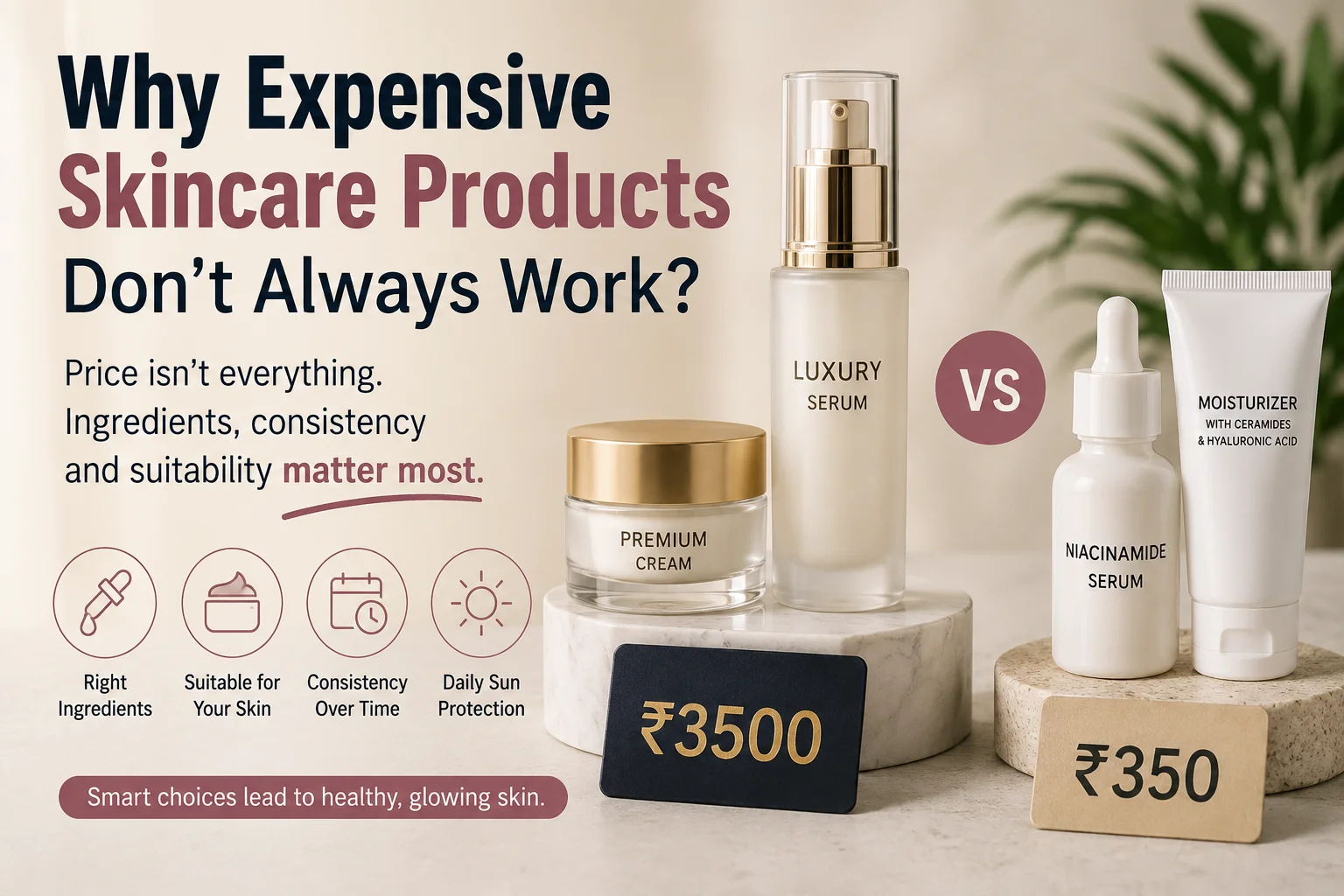
Why expensive skincare products don’t always work is a question many people ask after investing in premium creams or serums without seeing noticeable improvements. While some high-end products offer advantages, price alone does not determine how well a product performs. Your skin responds to ingredients, formulation, consistency, and suitability—not the number printed on the price tag.
Understanding what you are actually paying for can help you make smarter skincare decisions and avoid unnecessary expenses.
What Determines Whether a Skincare Product Works?
The effectiveness of a skincare product depends on several factors working together. A product that delivers excellent results for one person may do very little for another.
Some of the most important factors include:
- Your skin type
- The active ingredients
- The concentration of those ingredients
- The product formulation
- Consistency of use
- Sun protection during the day
- Your overall skin health
This is why buying the most expensive product on the shelf does not automatically lead to healthier skin.
Why Expensive Skincare Products Don’t Always Work?
1. Price Often Reflects Branding More Than Performance
Luxury skincare brands invest heavily in packaging, advertising, celebrity campaigns, and premium shopping experiences. These costs contribute to the final retail price.
Beautiful glass bottles, elegant fragrances, and premium textures certainly enhance the user experience. However, they do not necessarily improve how effectively a product treats acne, pigmentation, dryness, or signs of ageing.
Your skin cannot recognize luxury branding. It responds only to the ingredients applied to it.
2. The Same Active Ingredients Exist in Affordable Products
Many dermatologist-recommended ingredients are available in both affordable and premium skincare products.
These include:
- Niacinamide
- Vitamin C
- Hyaluronic acid
- Ceramides
- Retinoids
- Glycerin
- Sunscreen filters
The difference often lies in formulation quality, stability, and texture rather than the ingredient itself.
For basic daily care such as cleansing, moisturizing, and sun protection, affordable products frequently perform just as well as luxury alternatives.
3. More Expensive Does Not Mean More Suitable
A costly product can still irritate your skin if it is not designed for your skin type.
For example:
- Rich creams may clog oily skin.
- Strong exfoliating acids may damage sensitive skin.
- Highly fragranced products may trigger irritation.
- Heavy oils may worsen acne-prone skin.
The best skincare product is the one that matches your skin’s individual needs—not simply the one with the highest price.
4. Skincare Needs Time to Show Results
Many people expect visible improvements within a few days after buying an expensive product. When immediate changes do not happen, disappointment follows.
In reality, most skincare ingredients need several weeks of consistent use before noticeable improvements appear.
For example:
- Retinoids often require several weeks before improving skin texture.
- Pigmentation treatments usually take months rather than days.
- Barrier repair products work gradually with regular use.
- Collagen-supporting ingredients require patience.
No skincare product, regardless of price, can safely transform the skin overnight.
5. Marketing Can Create Unrealistic Expectations
Luxury skincare advertisements often promise glowing skin, wrinkle reduction, or flawless complexions with dramatic before-and-after images.
These campaigns create high expectations before the product is even opened.
As a result, people may assume every small improvement comes from the expensive product alone, while overlooking other factors such as better sleep, hydration, healthier eating habits, or consistent sunscreen use.
Healthy skin is usually the result of multiple habits working together rather than one premium cream.
When Expensive Skincare Can Be Worth the Investment?
Although price alone does not guarantee better results, premium skincare is not always a waste of money.
Some high-end formulations provide genuine advantages.
- Advanced ingredient stabilization technology.
- Better delivery systems for certain active ingredients.
- More elegant textures that encourage consistent use.
- Reduced irritation through carefully balanced formulations.
- Research-backed combinations of ingredients.
These benefits are often most noticeable in products designed for ageing skin, sensitive skin, or specialised concerns.
However, even the best formulation cannot replace an accurate diagnosis when an underlying skin condition is present.
When Skincare Products Alone Are Not Enough?
Sometimes the issue is not the quality of the product but the nature of the skin concern itself.
Persistent acne, stubborn pigmentation, rosacea, eczema, recurring skin infections, or unexplained rashes often require medical evaluation rather than repeated product changes.
If you continue buying increasingly expensive skincare without improvement, it may be time to understand when you should consult a dermatologist.
Similarly, maintaining a simple, consistent daily skincare routine often provides better long-term results than frequently switching between expensive products.
How to Choose Skincare Products Wisely?
Instead of asking, “Is this product expensive?”, ask more practical questions.
Consider the following before making a purchase:
- Does it match your skin type?
- Does it contain ingredients supported by scientific evidence?
- Can you use it consistently?
- Does it fit comfortably within your budget?
- Has it caused irritation during previous use?
A simple routine that you can follow every day is usually more effective than an expensive routine that you abandon after a few weeks.
Signs You May Need Professional Advice Instead of a New Product
There comes a point when switching skincare products repeatedly becomes unhelpful. Some skin concerns require professional assessment because the underlying cause cannot be solved by cosmetics alone.
You should consider consulting a dermatologist if:
- Acne continues despite several weeks of treatment.
- Pigmentation keeps returning.
- Your skin frequently becomes red or irritated.
- You develop painful cysts or recurring infections.
- Moles or skin spots begin changing in appearance.
- You experience unexplained hair loss along with skin problems.
Rather than purchasing another expensive serum, an accurate diagnosis may save both time and money.
What Dermatologists Consider Before Recommending Products?
Dermatologists do not recommend skincare based solely on price. Instead, they evaluate factors such as:
- Your skin type
- Your medical history
- Current skin concerns
- Skin sensitivity
- Lifestyle habits
- Previous treatment response
Dr. Hera Tabassum, Chief Dermatologist, Cosmetologist, and Trichologist at Dr Hera’s Skin & Hair Clinic, Roorkee, believes that successful skincare begins with understanding the cause of the problem rather than simply choosing premium products. A personalised skincare plan is often more beneficial than buying multiple luxury products without knowing what your skin actually needs.
Affordable Skincare Essentials Worth Investing In
Many people achieve healthy skin with a straightforward routine built around a few well-formulated products.
- A gentle cleanser
- A moisturiser suited to your skin type
- A broad-spectrum sunscreen
- One or two targeted treatment products recommended for your concern
Adding too many expensive products at once can make it difficult to identify what is helping and what may be causing irritation.
Final Thoughts
Why expensive skincare products don’t always work comes down to one simple fact: price is only one part of the equation. Your skin responds to the right ingredients, proper formulation, regular use, and products that suit your individual needs.
Luxury skincare can offer benefits in some situations, particularly through advanced formulations and improved product stability. However, these advantages do not guarantee better results for everyone.
If your skin concern persists despite using well-formulated products consistently, changing to an even more expensive cream is unlikely to solve the problem. Seeking guidance from a qualified dermatologist can help identify the underlying cause and ensure you receive advice that is appropriate for your skin.
Frequently Asked Questions
1. Do expensive skincare products work better than affordable ones?
Not necessarily. Many affordable products contain the same evidence-based ingredients found in premium skincare. The right formulation for your skin matters more than the price.
2. Why are luxury skincare products more expensive?
The higher cost often reflects premium packaging, branding, research, marketing, and product experience. These factors do not always translate into better skin results.
3. Can affordable skincare products provide good results?
Yes. Gentle cleansers, moisturisers, sunscreens, and many treatment products can be highly effective when they suit your skin type and are used consistently.
4. When should I stop changing skincare products?
If you have used a suitable product consistently for several weeks without improvement, or your skin condition continues to worsen, consult a dermatologist instead of repeatedly trying new products.
5. Should I buy skincare based on price or ingredients?
Choose products based on your skin type, evidence-based ingredients, formulation quality, and professional advice when needed. These factors are more reliable indicators of effectiveness than price alone.