
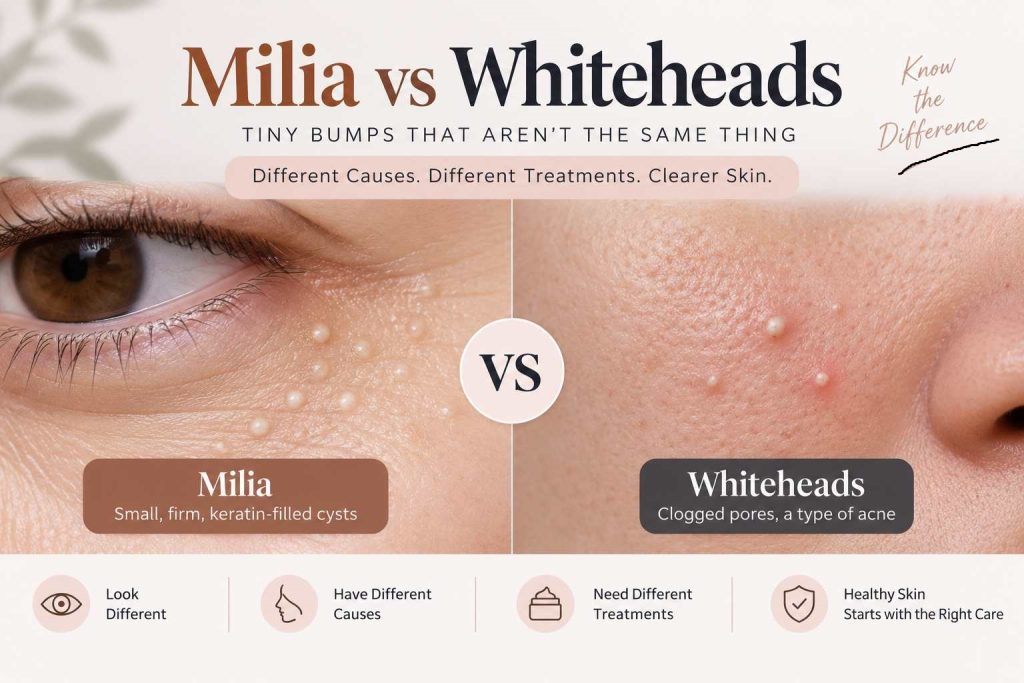
Tiny white bumps on your face can easily be mistaken for acne. But what looks like a stubborn whitehead may actually be milia, and treating the two conditions in the same way can irritate your skin without solving the problem.
The main difference is simple: whiteheads are a type of acne caused by a blocked hair follicle, while milia are small keratin-containing cysts that form beneath the surface of the skin.
They can also differ in texture, location, behaviour and treatment.
Quick Answer: Milia vs Whiteheads
Milia usually feel firm, smooth and pearl-like. They commonly appear around the eyes, eyelids, cheeks and forehead and may remain almost unchanged for weeks or months.
Whiteheads, also called closed comedones, develop when sebum and dead skin cells block a hair follicle. They are commonly found in acne-prone areas such as the forehead, nose, chin, cheeks, chest and upper back.
Because both can appear white or skin-coloured, appearance alone is not always enough for a definite diagnosis.
Milia vs Whiteheads at a Glance
| Feature | Milia | Whiteheads |
|---|---|---|
| What are they? | Small keratin-containing cysts | Closed comedones, a form of acne |
| Main cause | Keratin becomes trapped beneath the skin | Oil and dead skin cells plug a hair follicle |
| Texture | Usually firm or hard | Usually softer or less firm |
| Common colour | Pearly white to pale yellow | White or skin-coloured |
| Common locations | Eyelids, under-eye area, cheeks, forehead, nose | Forehead, nose, chin, cheeks, chest and back |
| Inflammation | Usually none | Often non-inflamed, although acne may occur nearby |
| Duration | May remain for weeks or months | May change or improve as acne changes |
| Acne treatment response | Often limited | Frequently responds to comedonal acne treatment |
| Should you squeeze it? | No | No—picking can cause irritation and scarring |
| Professional treatment | Extraction or other dermatologist-directed options when required | Topical acne treatment and, in selected cases, professional extraction |
What Are Milia?
A single milia cyst is technically called a milium. Milia are tiny cysts containing keratin, one of the proteins naturally present in the outer layers of your skin.
They typically look like small white or pale-yellow beads sitting just beneath the skin.
Unlike acne, milia are not primarily caused by excess oil clogging a pore.
They are generally harmless and painless.
Where Do Milia Usually Appear?
Milia commonly develop around the eyelids and under the eyes, but they can also occur on the cheeks, forehead and nose.
This location can provide a useful clue. A tiny, firm bump sitting near the eye and remaining unchanged for a long period is more suggestive of milia than a typical acne breakout, although only an examination can confirm the diagnosis.
Are There Different Types of Milia?
Yes.
Primary milia can occur spontaneously in children and adults, particularly around the eyelids and cheeks.
Neonatal milia are extremely common in babies and usually disappear naturally within a few weeks.
Secondary or traumatic milia can develop while damaged skin is healing, for example after certain burns, blistering conditions or skin procedures.
There are also less common forms such as multiple eruptive milia and milia en plaque.
What Are Whiteheads?
Whiteheads are a type of acne medically known as closed comedones.
They form when a hair follicle becomes blocked with a combination of sebum and dead skin cells while the follicular opening remains closed at the surface.
This produces a small white or flesh-coloured bump.
Whiteheads are especially common in areas with more sebaceous glands, including the forehead, nose, chin, cheeks, chest and upper back.
You may have whiteheads alongside other types of acne such as blackheads, inflammatory pimples or pustules.
How Can You Tell If a Bump Is Milia or a Whitehead?
There isn’t one perfect home test, and relying only on whether you can see a pore can be misleading because a whitehead is itself a closed comedone.
Instead, consider several clues together.
1. Feel the Texture
Milia often feel noticeably firm, almost like a tiny grain sitting underneath the skin.
Whiteheads can also feel raised, but they generally do not have the same distinctly hard, pearl-like texture.
2. Look at the Location
Clusters of tiny firm bumps around the eyelids or under-eye area commonly turn out to be milia.
Whiteheads are more likely to accompany acne across the T-zone, cheeks, jawline, chest or back.
Location alone cannot make the diagnosis, but it can help.
3. Watch What Happens Over Time
A whitehead may change as an acne breakout develops or clears.
Milia may remain almost identical in appearance for weeks or months.
A bump that has remained small, firm and unchanged despite your usual acne routine deserves a closer look rather than increasingly aggressive treatment.
4. Check for Other Acne
If you also have oily skin, blackheads, inflammatory pimples or repeated breakouts in the same area, the white bumps may be closed comedones.
Isolated pearly bumps around the eyes without other acne signs are more suggestive of milia.
What Causes Milia?
Primary milia develop when keratin becomes trapped within a tiny cyst close to the surface of the skin.
Secondary milia can develop following damage to the skin during the healing process. Dermatology references describe secondary milia after burns, blistering diseases, dermabrasion and some topical medications.
This means it is too simplistic to say that every case of milia is caused by “heavy eye cream” or inadequate exfoliation.
Skincare can influence how your skin behaves, but persistent white bumps should be identified correctly before you change several products or start aggressive exfoliation.
What Causes Whiteheads?
Whiteheads develop through the acne process.
Excess sebum and abnormal accumulation of dead skin cells can block a hair follicle, producing a closed comedone.
Hormonal changes can increase sebum production, which is one reason acne is common during adolescence, although adults can develop whiteheads too.
Certain cosmetic or skincare products may also aggravate comedonal acne in acne-prone people.
Why Acne Products May Help Whiteheads but Not Milia
This is one of the most important differences between milia and whiteheads.
Because whiteheads develop within clogged follicles, ingredients that help normalise follicular shedding and prevent blockage can be useful.
Depending on your skin and the severity of acne, a dermatologist may recommend treatments containing ingredients such as salicylic acid, topical retinoids, azelaic acid or benzoyl peroxide as part of an appropriate acne routine.
Milia work differently.
Although certain topical treatments, including retinoids, may sometimes be recommended for multiple or persistent milia, an individual established milium may not simply disappear because you use a stronger acne cleanser.
Repeatedly applying harsh acids to a bump—particularly around the eye—can instead cause irritation.
Can You Pop Milia?
You should not try to pop or pierce milia at home.
A milium is covered by skin, so repeatedly squeezing it often results in redness, bruising, broken skin or post-inflammatory pigmentation rather than removing the cyst.
The risk is even more important around the eyelids, where the skin is thin and the eye itself is nearby.
When removal is appropriate, a trained medical professional can make a tiny sterile opening and remove the contents using the correct technique.
Should You Pop Whiteheads?
Picking or squeezing whiteheads is also discouraged.
Pressure can increase inflammation and skin injury and may contribute to dark marks or acne scarring.
Instead of extracting individual whiteheads repeatedly, treatment should focus on preventing new comedones from forming.
How Are Whiteheads Treated?
Treatment depends on how widespread your acne is, your skin type and whether inflammatory acne is also present.
For mild comedonal acne, treatment often focuses on gentle cleansing, a suitable moisturiser, sunscreen and ingredients that reduce follicular blockage.
Salicylic acid can help remove dead skin cells that contribute to clogged follicles.
Topical retinoids are commonly used to treat and prevent comedones.
Other treatments may be recommended when whiteheads occur alongside inflammatory acne.
More severe, widespread or persistent acne should be assessed by a dermatologist rather than treated by continuously adding new products.
How Are Milia Treated?
Many milia are harmless and do not medically require treatment.
Some resolve naturally with time.
When adult milia persist and their appearance bothers you, a dermatologist can first confirm that the bumps are actually milia and then discuss suitable treatment.
Depending on the number, size and location of the lesions, professional treatment may include sterile de-roofing and extraction or other dermatologist-directed procedures.
Widespread milia sometimes require a different approach from one or two isolated cysts.
What About Milia Under the Eyes?
The under-eye area deserves extra caution.
Not every tiny bump around the eyes is milia. Other conditions can sometimes resemble them, including syringomas, xanthelasma and other benign skin lesions.
Avoid needles, extraction tools, strong peels and aggressive scrubbing around this area.
If an under-eye bump is persistent and you are unsure what it is, a dermatologist can identify it before treatment.
Can You Prevent Milia and Whiteheads?
There is no guaranteed way to prevent every case of milia.
For general skin health, avoid repeatedly damaging or over-exfoliating the skin and use sunscreen regularly.
If a particular product repeatedly seems to coincide with new facial bumps, discuss your routine with a dermatologist rather than assuming every white bump is caused by clogged pores.
For whiteheads, a consistent acne-friendly routine can make a larger difference. Gentle cleansing, non-comedogenic skincare and suitable comedonal acne treatment can help reduce repeated follicular blockage.
Milia, Whitehead or Something Else?
Not every white or skin-coloured bump is either milia or acne.
Small facial bumps can also be caused by conditions such as syringomas, sebaceous hyperplasia and other cysts or benign growths.
A bump should be examined rather than self-treated if it keeps growing, changes colour or shape, becomes painful, repeatedly bleeds, forms a persistent sore, or simply does not behave like ordinary acne.
When Should You See a Dermatologist?
Consider getting professional advice when tiny white bumps persist despite appropriate skincare, repeatedly return, occur very close to the eye, become red or painful, or you cannot confidently tell whether they are milia or acne.
A correct diagnosis matters because repeatedly treating milia as acne may only irritate your skin, while untreated comedonal acne may continue producing new whiteheads.
For persistent milia, whiteheads or other unexplained facial bumps in Roorkee, you can consult a dermatologist at Dr Hera Skin Clinic for diagnosis and a treatment plan based on your skin rather than trial-and-error skincare.
Frequently Asked Questions
What is the main difference between milia and whiteheads?
Milia are small keratin-containing cysts underneath the skin, whereas whiteheads are closed comedones caused when oil and dead skin cells block a hair follicle. Milia are not a type of acne.
How do I know whether I have milia or whiteheads?
Milia usually feel firmer, often appear around the eyes or cheeks and may stay almost unchanged for weeks or months. Whiteheads more commonly occur in acne-prone areas and may appear alongside blackheads or pimples. Because the two can look similar, persistent bumps are best diagnosed by a dermatologist.
Is milia a type of acne?
No. Milia are small cysts containing keratin. Whiteheads, in contrast, are a form of comedonal acne.
Can salicylic acid remove milia?
Salicylic acid is commonly used for clogged pores and comedonal acne, including whiteheads. Established milia do not behave like ordinary clogged pores, so trying increasingly strong salicylic acid products may not remove them and can irritate sensitive skin.
Do milia go away naturally?
Some milia resolve without treatment. Neonatal milia usually clear spontaneously, while primary milia in older children and adults may disappear within weeks or persist for months or longer.
Can I squeeze milia out at home?
No. Squeezing or piercing milia at home can damage the skin and cause infection, pigmentation or scarring. Professional removal is safer when treatment is needed.
Are whiteheads painful?
Many whiteheads are not painful because they are non-inflammatory acne lesions. Tenderness, redness or swelling can indicate that inflammation is developing or that the bump may be another type of acne lesion.
Why do I get tiny white bumps around my eyes?
Milia are one common cause, but they are not the only possibility. Syringomas and several other skin conditions can create similar-looking bumps around the eyes. A dermatologist can distinguish between them during an examination.
Can milia turn into whiteheads or pimples?
Milia and whiteheads develop through different processes. A milium does not need to “turn into” a whitehead. However, a person can have both milia and acne at the same time.
Should I see a dermatologist for milia?
Milia are usually harmless, so medical treatment is not always necessary. See a dermatologist if the diagnosis is uncertain, the bumps are persistent or widespread, they are close to the eye, or you want them removed safely.
Final Takeaway
Milia and whiteheads may look similar, but they are not the same condition.
Milia are usually firm, keratin-containing cysts that frequently appear around the eyelids and cheeks. Whiteheads are closed comedones formed when oil and dead skin cells block hair follicles.
That difference is why the same treatment does not work equally well for both.
Rather than squeezing tiny white bumps or repeatedly adding stronger acne products, first identify what you are actually treating. When the diagnosis is uncertain or the bumps persist, a dermatologist can help distinguish milia, comedonal acne and other look-alike conditions and recommend appropriate treatment.