
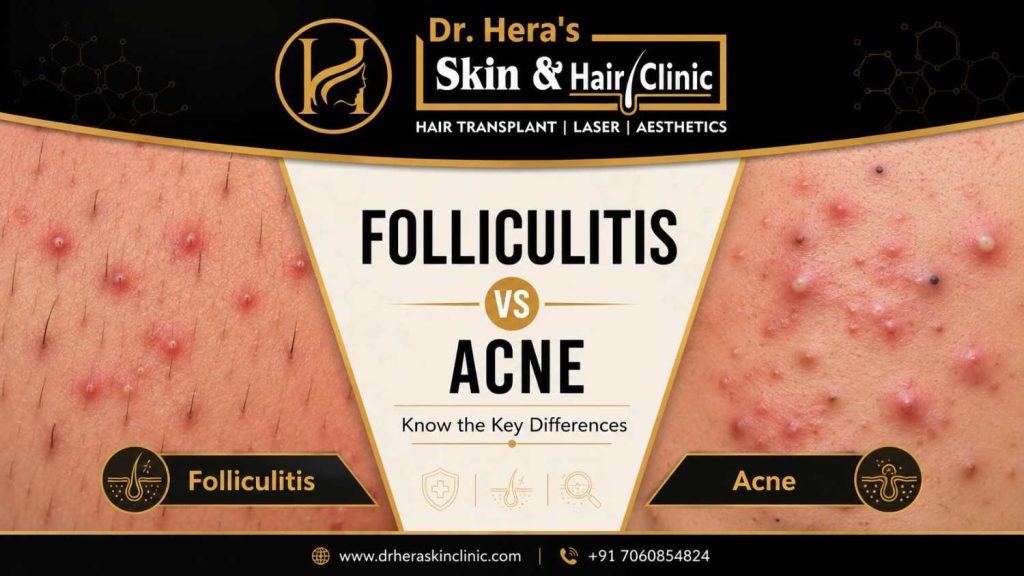
Red or pus-filled bumps on the face, chest, back, arms, or other parts of the body are often assumed to be acne. However, not every pimple-like breakout is acne.
Folliculitis and acne can look similar, but they develop differently and may require different treatment approaches. Acne commonly causes blackheads, whiteheads, inflamed pimples, and sometimes deeper painful bumps. Folliculitis usually appears as small, similar-looking bumps that develop around hair follicles and may feel itchy or tender.
Knowing the difference between folliculitis vs acne can help you avoid using the wrong skincare products or treatments.
Quick Answer: Is It Folliculitis or Acne?
Acne is more likely when you have:
- Blackheads
- Whiteheads
- Different types and sizes of pimples
- Deep or painful acne lesions
- Breakouts mainly on the face, chest, shoulders, or back
Folliculitis may be more likely when you have:
- Small, similar-looking bumps
- Bumps developing around individual hairs
- Noticeable itching or burning
- Breakouts after shaving or waxing
- Bumps after heavy sweating or friction
- Sudden clusters of acne-like pustules
These signs can help differentiate the two conditions, but a skin examination may be necessary when the diagnosis is unclear.
Folliculitis vs Acne: Key Differences
| Feature | Folliculitis | Acne |
| Main problem | Inflammation of hair follicles | Blocked and inflamed follicles |
| Appearance | Small, similar-looking red bumps or pustules | Blackheads, whiteheads, pimples, nodules |
| Blackheads | Usually absent | Common |
| Whiteheads | True comedones usually absent | Common |
| Itching | More common | Less common |
| Pain | May be tender | Inflamed acne can be painful |
| Hair in the centre | May be visible | Not a typical identifying feature |
| Common triggers | Shaving, friction, sweat, microorganisms | Hormones, excess oil, blocked pores |
| Common areas | Beard, thighs, buttocks, arms, chest, back | Face, shoulders, chest, upper back |
What Is Folliculitis?
Folliculitis is inflammation of one or more hair follicles.
It can develop anywhere on the body where hair grows. It often looks like a group of small pimples and may be mistaken for acne.
Folliculitis can occur due to infection, irritation, friction, shaving, sweating, or other causes.
Common causes and triggers may include:
- Bacterial infection
- Yeast affecting the follicles
- Shaving or waxing
- Tight clothing
- Excessive sweating
- Heat and moisture
- Friction
- Irritation of the hair follicles
- Poorly maintained hot tubs or pools
Different forms of folliculitis may require different treatment approaches, which is why identifying the cause is important.
What Does Folliculitis Look Like?
Common signs may include:
- Small red bumps
- Pus-filled bumps
- Bumps centred around hairs
- Similar-sized spots appearing together
- Itching
- Burning sensation
- Tenderness
- Redness around the follicles
One useful clue is that many folliculitis bumps tend to look very similar to one another.
What Is Acne?
Acne, also known as acne vulgaris, develops when hair follicles become blocked with excess oil and dead skin cells. Inflammation can then develop within the blocked follicle.
Acne can appear in several forms, including:
- Blackheads: Open clogged pores that appear dark at the surface.
- Whiteheads: Closed clogged pores that appear as small raised bumps.
- Papules: Small red and inflamed bumps.
- Pustules: Inflamed pimples containing pus.
- Nodules: Deeper, firm, and often painful acne lesions.
- Cystic Acne: Deeper inflammatory lesions that may carry a higher risk of scarring.
The presence of blackheads and whiteheads is an important clue that a breakout may be acne rather than folliculitis.
7 Differences Between Folliculitis and Acne
1. Blackheads and Whiteheads
Acne commonly produces blackheads and whiteheads.
Folliculitis usually does not cause true blackheads or whiteheads.
If you have blocked pores along with inflamed pimples, acne becomes more likely.
2. Appearance of the Bumps
Folliculitis often creates bumps that look similar in size and shape.
Acne can produce several different types of spots at the same time.
For example, someone with acne may have blackheads, whiteheads, red pimples, and a deeper painful bump in the same area.
3. Itching
Folliculitis can be noticeably itchy, particularly in some types of yeast-related folliculitis.
Acne may feel sore or tender, especially when inflammation is deeper, but significant itching is generally less characteristic.
4. Relationship With Hair Follicles
Folliculitis develops directly around hair follicles.
In some cases, a hair may be visible in the centre of the bump.
Acne also develops within the follicular unit, but blocked pores and mixed acne lesions usually produce a different overall appearance.
5. Recent Triggers
Folliculitis may appear after:
- Shaving
- Waxing
- Heavy sweating
- Tight clothing
- Friction
- Hot and humid conditions
Acne may be influenced by:
- Hormonal changes
- Excess oil production
- Blocked pores
- Genetics
- Certain skincare or hair products
- Some medicines
6. Location
Acne commonly affects:
- Face
- Forehead
- Jawline
- Chest
- Shoulders
- Upper back
Folliculitis commonly affects:
- Beard area
- Neck
- Arms
- Thighs
- Buttocks
- Legs
- Chest
- Back
Location alone cannot confirm the condition, but it can provide another useful clue.
7. Response to Acne Treatment
Sometimes a person keeps treating a breakout as acne but sees little improvement.
If acne products are not helping and the bumps remain very itchy, uniform, or repeatedly return after shaving, sweating, or friction, the diagnosis may need to be reconsidered.
Using stronger acne products without knowing the actual cause may also irritate the skin further.
What Is Fungal Acne?
The term “fungal acne” is commonly used online, but it is not ordinary acne.
What people often call fungal acne is usually Malassezia folliculitis, where yeast affects the hair follicles.
It may cause:
- Small, similar-looking bumps
- Itchy breakouts
- Bumps on the forehead or hairline
- Chest or shoulder breakouts
- Upper-back bumps
Fungal Folliculitis vs Acne
| Fungal Folliculitis | Acne |
| Related to yeast affecting follicles | Develops through blocked and inflamed follicles |
| Often itchy | Itching is less typical |
| Bumps often look similar | Acne lesions usually vary |
| Blackheads usually absent | Blackheads may be present |
| Common on forehead, chest and back | Common on face, chest and back |
| Requires cause-specific management | Requires acne-specific management |
This is one reason self-diagnosing “fungal acne” from photographs or social media can be misleading.
Can Folliculitis and Acne Occur Together?
Yes.
A person can have acne and folliculitis at the same time.
For example, someone may have regular acne on the face while developing folliculitis on areas affected by shaving or friction.
Malassezia folliculitis and acne may also coexist, which can make the skin condition more difficult to identify without proper examination.
Why Does the Difference Matter?
The most important reason to differentiate acne vs folliculitis is that their treatment may be different.
A treatment that works well for blocked pores and acne may not treat folliculitis caused by irritation, bacteria, yeast, or another trigger.
Similarly, using antibiotic or antifungal medicines without confirming the cause is not advisable.
Correct diagnosis should come before treatment.
How Is Acne Treated?
The treatment of acne depends on the type and severity of the condition.
A dermatologist may recommend options such as:
- Gentle skincare
- Benzoyl peroxide
- Retinoid-based treatment
- Azelaic acid
- Other topical medicines
- Oral medicines in selected cases
- Hormonal treatment in appropriate patients
- Procedures for selected acne concerns
There is no single acne treatment that is suitable for everyone.
Persistent, severe, painful, or scar-forming acne should be evaluated by a dermatologist.
Related: Acne Treatment in Roorkee
How Is Folliculitis Treated?
Folliculitis treatment depends on its cause.
Management may differ depending on whether the problem is associated with:
- Bacteria
- Yeast
- Shaving
- Friction
- Sweat
- Irritation
- Another underlying skin condition
For some people, reducing friction or temporarily stopping the activity triggering the inflammation may help.
Persistent, recurrent, widespread, or painful folliculitis may require medical evaluation.
Avoid starting antibiotics, antifungal medicines, or strong acne products simply because the bumps look a certain way.
What Can You Do If You Are Not Sure?
If you are unsure whether you have folliculitis or acne, avoid aggressively treating the skin until the cause becomes clearer.
Some general measures include:
- Use a gentle cleanser
- Avoid squeezing or picking bumps
- Avoid aggressive scrubbing
- Change out of sweaty clothes after exercise
- Shower after heavy sweating
- Avoid tight clothing over the affected area
- Keep razors clean
- Avoid sharing razors and towels
- Temporarily reduce shaving or waxing if it triggers bumps
- Avoid repeatedly adding new active skincare products
These steps can help reduce unnecessary irritation while you determine what is causing the breakout.
Can Shaving Cause Folliculitis?
Yes. Shaving can irritate or damage hair follicles and may contribute to folliculitis.
However, some shaving-related bumps may actually be pseudofolliculitis barbae, commonly called razor bumps.
Razor bumps occur when cut hairs curve back into the skin and cause inflammation.
This condition can resemble both acne and folliculitis, particularly around the beard and neck.
If bumps repeatedly develop after shaving, identifying the actual cause can help determine the appropriate approach.
Can Sweat Cause Folliculitis or Acne?
Sweat alone is not always the direct cause of acne or folliculitis.
However, sweat combined with:
- Heat
- Moisture
- Tight clothing
- Friction
- Occlusion
may irritate the follicles and contribute to breakouts.
Changing out of damp clothes after exercise and keeping the skin clean without excessive scrubbing can help reduce irritation.
How Does a Dermatologist Tell the Difference?
A dermatologist may assess several factors when distinguishing folliculitis from acne.
These include:
- Presence of blackheads or whiteheads
- Shape and size of the bumps
- Whether all lesions look similar
- Whether bumps develop around hairs
- Whether the breakout itches or hurts
- Location on the body
- Shaving or waxing habits
- Sweat and friction exposure
- Previous skincare or medicines
- Response to previous treatment
In recurrent or unusual cases, additional investigation may sometimes be needed.
Can Folliculitis or Acne Leave Dark Marks?
Yes.
Inflammation from either condition can sometimes leave darker marks after the original bumps have settled. This is known as post-inflammatory hyperpigmentation.
These marks may be more noticeable and persistent in people with medium to deeper skin tones.
Repeated squeezing, scratching, or picking can increase inflammation and make marks more noticeable.
Severe acne may also leave permanent acne scars, while some deeper or recurrent forms of folliculitis can occasionally cause scarring.
When Should You See a Dermatologist?
Consider consulting a dermatologist if:
- You cannot tell whether the bumps are acne or folliculitis
- The condition repeatedly returns
- Your regular acne treatment is not working
- The bumps are very itchy
- The area is painful
- The breakout is spreading
- Pus-filled bumps keep developing
- Dark marks are increasing
- Scarring is developing
- The condition is affecting a large area
- Symptoms persist despite basic skincare
Seek medical attention promptly if redness or pain is rapidly spreading or if you develop fever, chills, or feel generally unwell.
A Dermatologist’s Perspective: Not Every Pimple-Like Bump Is Acne
One common mistake is assuming that every red bump needs stronger acne treatment.
The overall appearance of the skin matters.
A dermatologist looks at whether the skin has:
- Blackheads
- Whiteheads
- Similar-looking bumps
- Significant itching
- Hair-centred pustules
- Deep painful lesions
- Shaving-related inflammation
- Friction-related breakouts
When someone has been treating a condition as acne for several weeks without improvement, simply adding more acne products may not be the right next step.
Sometimes the diagnosis itself needs to be reconsidered.
About Dr. Hera Tabassum
Dr. Hera Tabassum is the Chief Dermatologist, Cosmetologist and Trichologist at Dr Hera’s Skin & Hair Clinic in Roorkee.
She has completed MBBS and MD Dermatology from JNMCH, AMU, Aligarh, and also holds the Speciality Certificate Examination in Dermatology (MRCP-SCE) from the Royal College of Physicians, London.
Her professional training also includes dermatologic surgery, aesthetic dermatology, and laser procedures.
At Dr Hera’s Skin & Hair Clinic, skin and hair concerns are evaluated before an appropriate treatment plan is recommended.
Frequently Asked Questions
What is the main difference between folliculitis and acne?
Acne usually causes blocked pores such as blackheads and whiteheads along with different types of pimples. Folliculitis is inflammation of hair follicles and often causes similar-looking red or pus-filled bumps around hairs.
Is folliculitis itchy?
Folliculitis can be itchy, especially in some forms such as Malassezia folliculitis. Acne is more commonly associated with tenderness or pain when inflammation is deeper.
Does folliculitis cause blackheads?
True blackheads are not usually a feature of folliculitis. Blackheads and whiteheads are more characteristic of acne.
Is fungal acne actually acne?
No. The term fungal acne usually refers to Malassezia folliculitis, which affects the hair follicles and is different from acne vulgaris.
Can folliculitis look like pimples?
Yes. Folliculitis can cause red and pus-filled bumps that closely resemble pimples.
Can I have folliculitis and acne at the same time?
Yes. Both conditions can occur together.
Why do I get itchy bumps after sweating?
Heat, sweat, moisture, friction, and tight clothing can irritate hair follicles and may contribute to some forms of folliculitis. Persistent or recurring bumps should be properly assessed.
Why do I get bumps after shaving?
Shaving can irritate hair follicles and contribute to folliculitis. Razor bumps caused by ingrown hairs can also look similar.
Will acne medicines treat folliculitis?
Not always. Folliculitis has different possible causes, and treatment depends on the underlying cause. Acne medicines may not be appropriate for every type of folliculitis.
When should I see a dermatologist?
Consult a dermatologist when the bumps are persistent, recurring, painful, very itchy, spreading, leaving scars or marks, or not improving with your current skincare or acne treatment.
Conclusion
The difference between folliculitis and acne is not always easy to identify by looking at one bump.
Acne commonly causes blackheads, whiteheads, and different types of pimples, while folliculitis often produces small, similar-looking bumps around hair follicles that may be itchy.
Shaving, sweating, heat, and friction may also point towards folliculitis, while blocked pores and mixed acne lesions may point more towards acne.
If your “acne” keeps returning or is not responding to your usual treatment, avoid repeatedly adding stronger products. Getting the condition properly identified may be more useful than trying another acne treatment.
For persistent acne-like bumps or recurrent folliculitis, you can consult Dr. Hera Tabassum at Dr Hera’s Skin & Hair Clinic, Roorkee for a dermatology assessment.