
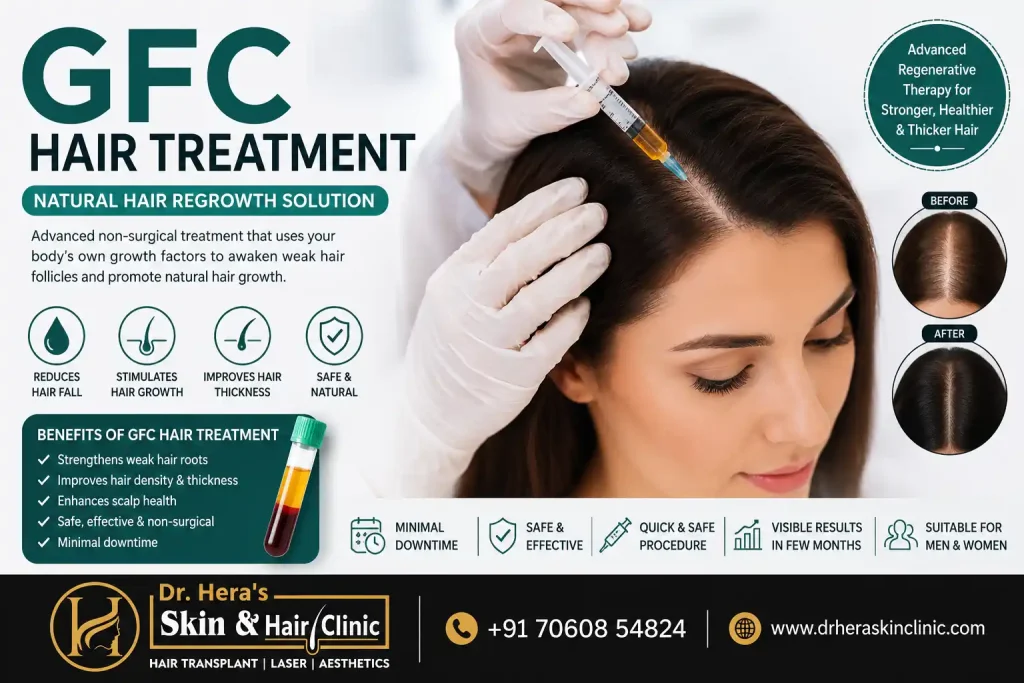
Hair loss and hair thinning are very common these days. Stress, hormonal imbalance, poor nutrition, pollution, genetics, medical conditions, and unhealthy lifestyle habits can all cause problems with hair loss, thinning hair, receding hairlines, weak hair roots, and gradual baldness in both men and women.
A lot of people try oils, shampoos, supplements, and home remedies for months on end without seeing any results. This is because most problems with hair loss start deep in the scalp, at the follicle level, where most hair care products don’t work well.
Because of this, regenerative hair restoration treatments like GFC therapy are gaining popularity for improving scalp health and stimulating natural hair growth.
GFC therapy is an advanced non-surgical procedure designed to support natural hair regrowth and strengthen weak follicles. It uses highly concentrated natural growth factors taken from the patient’s own blood to wake up hair follicles that are weak or sleeping. The treatment is meant to stop hair loss, make the scalp healthier, strengthen hair roots, and promote better natural hair growth.
Many dermatologists think that GFC is a better and more advanced way to get hair to grow back than traditional PRP therapy because it sends concentrated growth factors directly to the scalp where hair loss is happening.
Before suggesting a hair restoration treatment plan for each patient at Dr. Hera Skin & Hair Clinic, Dr. Hera Tabassum carefully checks the condition of the scalp, the stage of hair loss, the health of the hair follicles, and the overall hair density.
This guide tells you everything you need to know about GFC hair treatment, including its pros and cons, how it works, how much it costs, how long it takes to heal, the results, and whether it is the right treatment for your hair loss.
What is GFC Hair Treatment?
Growth Factor Concentrate is what GFC stands for.
It is a high-tech hair treatment that uses growth factors that have been cleaned from the patient’s own blood to naturally stimulate hair follicles and encourage healthier hair growth.
Growth factors are proteins that are naturally found in platelets in the blood. As the body heals, these proteins help fix tissues, speed up cell growth, improve blood flow, and help the body’s healing processes.
During the procedure, a small amount of blood is taken from the patient and processed with special medical equipment to separate out the concentrated growth factors. Then, these clean growth factors are injected into places where hair is falling out or getting thinner.
The treatment works by making the biological environment around hair follicles better and activating healing processes on the scalp that help hair grow naturally.
GFC therapy goes after the cause of hair loss at the follicular level, unlike temporary cosmetic solutions.
How Does GFC Hair Treatment Work?
Strong hair follicles, good blood flow, oxygen, nutrients, and a healthy scalp environment are all important for hair growth.
When someone has androgenetic alopecia, hormonal hair loss, stress-related hair loss, or hair loss due to getting older, the hair follicles slowly get weaker and start making hair strands that are thinner and weaker.
Over time, the hair growth cycle gets shorter, hair density goes down, and more of the scalp is visible.
The GFC treatment works by putting very concentrated growth factors right into the scalp. These growth factors help to increase follicular activity, improve blood flow to the scalp, and help damaged tissue grow back around follicles.
Once injected into the scalp, the growth factors help:
- Improve blood supply around hair follicles
- Stimulate dormant or weakened roots
- Increase nutrient delivery
- Support collagen production
- Improve scalp healing
- Strengthen weak follicles
- Promote healthier hair growth cycles
As scalp health improves, many patients gradually notice reduced hair shedding, stronger hair shafts, and improvement in overall hair density.
Growth Factors Present in GFC Hair Treatment
GFC contains several important biological proteins that help stimulate scalp repair and follicular activity.
These may include:
- Platelet-Derived Growth Factor (PDGF)
- Vascular Endothelial Growth Factor (VEGF)
- Epidermal Growth Factor (EGF)
- Insulin-Like Growth Factor (IGF)
- Fibroblast Growth Factor (FGF)
These growth factors collectively support scalp rejuvenation and hair follicle stimulation.
Benefits of GFC Hair Treatment
One of the main reasons GFC therapy is becoming more and more popular is that it is a treatment that doesn’t involve surgery and has natural benefits for healing.
GFC treatment doesn’t leave stitches, scars, or long periods of not being able to do things like surgery does.
The treatment might help stop hair loss while also making the quality of the hair that is already there better overall.
Some of the major benefits of GFC hair treatment include:
- Reduction in excessive hair shedding
- Improvement in hair thickness and density
- Strengthening of weak hair roots
- Better scalp circulation
- Healthier scalp environment
- Stimulation of dormant follicles
- Improvement in hair texture
- Natural-looking hair regrowth
- Minimal downtime and recovery
The fact that the treatment uses the patient’s own blood-derived growth factors is another big plus. This greatly lowers the risk of allergic reactions or other serious problems.
GFC Hair Treatment vs PRP Hair Treatment
A lot of people get GFC therapy and PRP hair treatment mixed up because both use the patient’s own blood.
But the two treatments are not the same in important ways.
Platelet-rich plasma is used in PRP therapy, while purified growth factors are used in GFC therapy in a more concentrated and targeted form.
Many people think that GFC treatment is more advanced because it gets rid of unwanted parts of the blood and sends highly concentrated regenerative proteins straight to the scalp.
Compared to traditional PRP, GFC therapy may offer:
- Better purity
- Reduced inflammation
- More targeted follicle stimulation
- Better patient comfort
- More concentrated growth factors
Both treatments can work, but the best one depends on the condition of the patient’s scalp, the amount of hair loss, and the treatment goals.
Who is a Good Candidate for GFC Hair Treatment?
GFC hair treatment might work for both men and women whose hair loss or thinning is in its early to moderate stages.
The treatment is commonly recommended for individuals dealing with:
- Pattern baldness
- Excessive hair shedding
- Weak hair roots
- Diffuse hair thinning
- Hormonal hair fall
- Stress-related hair loss
- Reduced hair density
- Postpartum hair thinning
People whose hair follicles are still active or mostly active are usually the best candidates.
People whose hair follicles are completely dormant or who are very bald may need other treatments, like hair transplants.
Who Should Avoid GFC?
Although GFC treatment is generally considered safe, it may not be suitable for everyone.
People with the following conditions may require medical evaluation before undergoing treatment:
- Active scalp infections
- Severe psoriasis on scalp
- Blood clotting disorders
- Severe uncontrolled diabetes
- Autoimmune scalp conditions
- Active cancer treatment
- Severe anemia
- Certain chronic medical illnesses
A proper consultation with a qualified dermatologist is important before starting treatment.
GFC Hair Treatment Procedure
The procedure starts with a thorough examination of the scalp and hair by the dermatologist.
Before planning the treatment, the doctor looks at the density of the hair, the health of the scalp, the stage of hair loss, and the condition of the hair follicles.
After that, a small amount of blood is taken from the patient. Specialized GFC tubes and centrifugation technology are used to separate the concentrated growth factors from the other parts of the blood.
After making the pure growth factor concentrate, the scalp is carefully cleaned and the solution is carefully injected into places where hair is thinning.
The whole process usually takes between 45 and 60 minutes.
Following treatment, most people can quickly get back to their normal lives.
Is GFC Treatment Painful?
The procedure starts with a thorough examination of the scalp and hair by the dermatologist.
Before planning the treatment, the doctor looks at the density of the hair, the health of the scalp, the stage of hair loss, and the condition of the hair follicles.
After that, a small amount of blood is taken from the patient. Specialized GFC tubes and centrifugation technology are used to separate the concentrated growth factors from the other parts of the blood.
After making the pure growth factor concentrate, the scalp is carefully cleaned and the solution is carefully injected into places where hair is thinning.
The whole process usually takes between 45 and 60 minutes.
Following treatment, most people can quickly get back to their normal lives.
Side Effects of GFC Hair Treatment
When done by a skilled dermatologist using clean medical methods, GFC hair treatment is usually safe.
The risk of an allergic reaction is very low because the treatment uses natural growth factors that come from the patient’s own blood.
However, some temporary side effects may occur after the procedure, including:
- Mild redness
- Scalp tenderness
- Temporary swelling
- Slight bruising
- Mild itching
- Temporary sensitivity
These side effects are usually mild and resolve within one to three days.
Serious complications are uncommon when the procedure is performed properly.
Recovery After GFC Hair Treatment
Because GFC therapy is minimally invasive, most people get better quickly afterward.
Most people can go back to their normal lives the same day or the next.
However, dermatologists may recommend avoiding:
- Heavy sweating
- Intense workouts
- Harsh scalp products
- Excessive sun exposure
- Hair coloring immediately after treatment
Following proper aftercare instructions helps improve healing and treatment outcomes.
How Many GFC Sessions Are Required?
The number of sessions required depends on multiple factors including:
- Severity of hair loss
- Age
- Follicle condition
- Scalp health
- Genetics
- Hormonal factors
Most people need three to four sessions at first, usually a few weeks apart.
You may also be told to have maintenance sessions every couple of months, depending on your hair condition and your long-term goals.
When Will You See Results from GFC Hair Treatment?
The process of hair growth is slow, so it takes time to see results.
Some people lose less hair in the first few weeks after treatment.
But after a few sessions, you should be able to tell that your hair is thicker and denser.
Typical timeline of results may include:
First Month
Reduction in active hair shedding and improvement in scalp quality.
2 – 3 Months
Hair texture may begin improving and thinning may appear reduced.
4 – 6 Months
Visible improvement in hair density, strength, and overall hair quality may become more noticeable.
Long-Term Maintenance
Getting regular maintenance sessions and taking good care of your hair may help the results last longer.
The exact time frame depends on how much hair loss there is and how the scalp reacts to it.
Are GFC Results Permanent?
Genetic hair loss can’t be stopped by any hair restoration treatment.
However, GFC therapy may greatly improve the health of the scalp and slow the loss of hair if it is used along with proper care and medical guidance.
The longevity of results depends on:
- Genetics
- Hormonal factors
- Lifestyle
- Nutrition
- Stress levels
- Consistency of maintenance sessions
Many patients maintain improvement for several months to years with proper follow-up care.
GFC Hair Treatment Cost in India
There are a few things that can change how much GFC hair treatment costs in India.
The overall cost depends on:
- Extent of hair loss
- Number of sessions required
- Clinic reputation
- Technology used
- Dermatologist expertise
- Combination therapies
- City and location
Patients with advanced hair thinning may require multiple sessions or combination treatments for better results.
Why Choosing the Right Dermatologist Matters
A lot of what makes GFC treatment work is getting the right diagnosis, checking out the scalp, using the right injection technique, and planning the treatment well.
There are many underlying reasons why people lose their hair, such as hormonal imbalances, nutritional deficiencies, thyroid disorders, stress, scalp infections, and their genes.
If the real cause isn’t found, hair restoration treatments might only make things slightly better.
A dermatologist with a lot of experience can correctly diagnose the problem and suggest the best way to treat it.
Can GFC Hair Treatment Be Combined with Other Hair Treatments?
Yes, GFC therapy is often combined with other hair restoration treatments depending on the patient’s condition.
Dermatologists may combine GFC with:
- PRP therapy
- Mesotherapy
- Microneedling
- Hair growth medications
- Nutritional supplements
- Laser-based scalp treatments
Combination approaches may help improve treatment outcomes in selected patients.
Hair Care Tips After GFC Treatment
Proper hair care after treatment can help improve and maintain results.
Dermatologists often recommend:
- Eating a protein-rich diet
- Managing stress levels
- Maintaining scalp hygiene
- Avoiding harsh chemical treatments
- Following prescribed medications regularly
- Staying hydrated
- Addressing nutritional deficiencies
Healthy lifestyle habits play an important role in long-term hair health.
Why Patients Choose Dr Hera Skin & Hair Clinic for Hair Restoration
Before treatment plans are made, every patient at Dr. Hera Skin & Hair Clinic has a thorough analysis of their scalp and hair.
Dr. Hera Tabassum specializes in dermatology that is based on scientific evidence and custom hair restoration methods that are based on the patient’s scalp condition, the amount of hair loss, and their long-term goals.
The clinic emphasizes:
- Personalized treatment planning
- Safe medical protocols
- Advanced regenerative therapies
- Comprehensive scalp evaluation
- Scientifically guided hair restoration
Frequently Asked Questions
Is GFC better than PRP for hair loss?
Many people think that GFC is a better and more advanced way to treat hair loss than traditional PRP therapy.
Can GFC regrow lost hair?
In some people, GFC may help wake up follicles that are weak or sleeping, which can lead to better natural hair growth.
How many sessions of GFC are required?
Most people need between 3 and 4 sessions at first, and then, if needed, maintenance sessions.
Is GFC treatment safe?
Yes, GFC treatment is generally safe when performed by a qualified dermatologist.
Is there any downtime after GFC treatment?
There isn’t much downtime, and most people get back to their normal lives quickly.
Does GFC treatment hurt?
There isn’t much downtime, and most people get back to their normal lives quickly.
Can women undergo GFC hair treatment?
Yes, GFC treatment can help both men and women whose hair is falling out or getting thinner.
How long do GFC results last?
The results depend on your genes, the condition of your scalp, the number of maintenance sessions you do, and your lifestyle.
Final Thoughts
The GFC Hair Treatment is a high-tech, non-surgical way to restore hair that is meant to stop hair loss, boost follicular activity, improve scalp health, and promote healthier hair growth.
People who are experiencing early hair loss, weak hair roots, low hair density, or pattern hair loss may find GFC therapy to be an effective regenerative treatment option if they do it with the help of an experienced dermatologist.
But treatment success depends on a correct diagnosis, reasonable expectations, regular sessions, a healthy scalp, and good hair care habits over time.
It is always best to talk to a professional before deciding if GFC treatment is the right choice for your hair problems.