
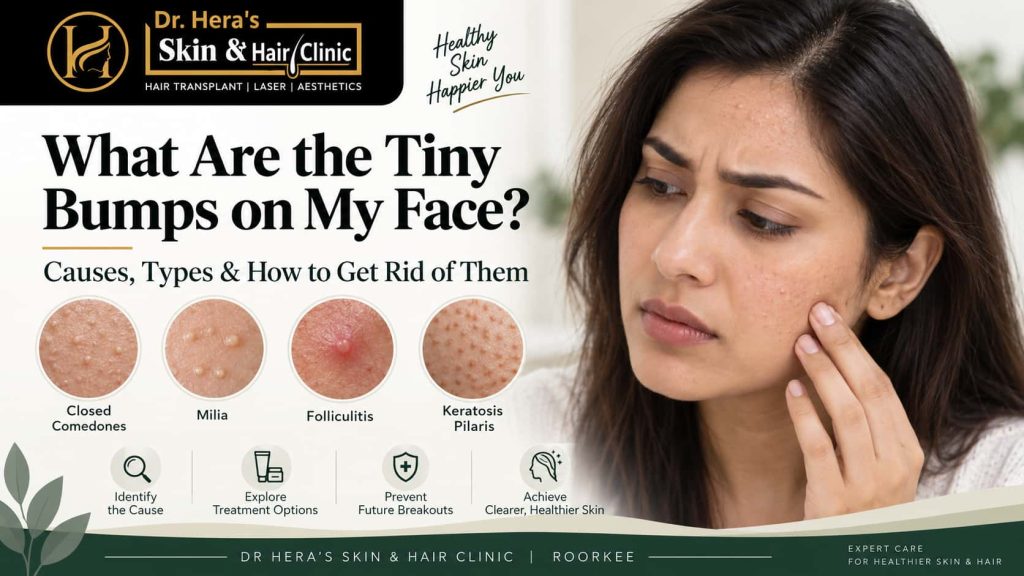
You wash your face and run your fingers over your skin. It looks almost normal in the mirror. But under bright light, you notice dozens of tiny bumps.
Some may be white. Others match your skin colour. A few may feel rough, itchy, red or even contain pus.
“What are the tiny bumps on my face, and how do I get rid of them?”
There is no single The first thought is usually:answer.
Tiny facial bumps can be caused by closed comedones, milia, folliculitis, keratosis pilaris, product irritation, perioral dermatitis or harmless skin growths.
That matters because a treatment that helps one type of bump may do nothing for another.
Quick Answer
Tiny bumps on the face are often caused by clogged pores, trapped keratin, inflammation around hair follicles or irritation from skincare and hair products.
Hard white bumps may be milia. Smooth skin-coloured bumps may be closed comedones. Rough bumps may be keratosis pilaris. Itchy, uniform or pus-filled bumps may suggest folliculitis.
The colour, feel, location and symptoms provide clues, but they cannot always confirm the diagnosis.
How Can You Tell What Type of Tiny Bumps You Have?
Before putting another acid, serum or spot treatment on your face, look at four things:
- Colour: Are they white, red, yellowish, brown or the same colour as your skin?
- Texture: Are they hard, smooth, rough, soft or fluid-filled?
- Location: Are they around the eyes, forehead, hairline, cheeks, chin or mouth?
- Symptoms: Do they itch, hurt, burn or produce pus?
That simple check often gives more useful information than asking whether a bump is “acne.”
| What the bumps look or feel like | Possible cause | Common location |
| Small, smooth, skin-coloured bumps | Closed comedones | Forehead, cheeks, chin |
| Firm, pearl-white bumps | Milia | Under eyes, cheeks, nose |
| Rough, sandpaper-like bumps | Keratosis pilaris | Cheeks, sometimes jaw |
| Red or pus-filled bumps | Acne or folliculitis | Face, hairline |
| Small, uniform and itchy bumps | Malassezia folliculitis | Forehead/hairline, sometimes face |
| Red or skin-coloured rash-like bumps | Perioral dermatitis | Around mouth, nose or eyes |
| Yellowish bump with a small central dip | Sebaceous hyperplasia | Forehead, cheeks, nose |
| Tiny clustered bumps around eyes | Syringomas | Lower eyelids and cheeks |
This table is a guide, not a diagnosis. Several conditions can look very similar.
What Is the Reason for Tiny Bumps on the Face?
There are several possible reasons.
- For some people, oil and dead skin cells block a pore.
- For others, keratin becomes trapped under the surface.
- Tiny bumps can also develop when a hair follicle becomes inflamed or infected.
- Dryness and excess keratin can create rough bumps.
- New cosmetics, sunscreen or hair products may also clog or irritate the skin.
- The important point is that “tiny bumps” describes appearance, not a medical diagnosis.
Let us look at the common causes one by one.
1. Closed Comedones: Tiny Skin-Coloured Bumps
If the bumps are smooth, small and mostly the same colour as your skin, they may be closed comedones, also called whiteheads.
They form when excess oil and dead skin cells block a pore.
Because the pore stays closed, you do not see the dark surface seen with a blackhead.
The American Academy of Dermatology describes whiteheads as raised white or flesh-coloured blemishes caused by oil and dead cells plugging a pore.
They often appear on the:
- Forehead
- Chin
- Cheeks
- Jawline
They may be easier to feel than to see.
Why do closed comedones develop?
Common contributors include increased oil production, dead-cell buildup and products that clog pores.
Hair products can also be overlooked.
The AAD notes that oils from shampoos, conditioners and styling products can cause small whiteheads or flesh-coloured bumps along the forehead and hairline. This is sometimes called acne cosmetica.
What helps?
Treatment is usually acne-directed rather than extraction at home.
Depending on the person, dermatologists may use pore-unclogging treatments such as topical retinoids, salicylic acid or other acne medicines.
Do not squeeze every bump.
Picking increases irritation and can contribute to marks or scars.
For broader acne management, internally link this section to your Acne Treatment in Roorkee page.
2. What Are the Tiny White Bumps on My Face?
White does not automatically mean “whitehead.”
If a bump is very firm, round and almost pearl-like, it may be milia.
Milia are tiny cysts that sit below the skin surface.
They commonly appear around the:
- Eyes
- Cheeks
- Nose
- Forehead
Cleveland Clinic describes milia as small white cysts under the skin and notes that they are commonly confused with acne whiteheads.
The difference matters.
A whitehead forms inside a clogged pore.
Milia contain trapped keratin beneath the surface.
That is why squeezing one often achieves nothing except irritating the skin.
Tiny hard white bumps on the face
If your search was:
“What are the tiny hard white bumps on my face?”
milia should be one possibility.
However, not every hard white bump is milia.
The area needs to be examined in context.
You already have a dedicated article for this search intent, so do not duplicate its complete explanation here.
Add the internal link:
Milia vs Whiteheads: How to Tell the Difference
This keeps the new article broad while allowing the existing page to rank for the comparison query.
3. Rough Tiny Bumps: Could It Be Keratosis Pilaris?
Some facial bumps do not feel smooth.
They feel dry or almost like fine sandpaper.
That may point toward keratosis pilaris, especially when the bumps occur on dry cheeks.
Keratosis pilaris develops when dead skin material forms plugs around hair follicles.
The American Academy of Dermatology describes the bumps as tiny, rough and sometimes similar to goosebumps or “chicken skin.” Children can develop them on their cheeks.
They can be:
- Skin Coloured
- White
- Red
- Pinkish
- Darker On Deeper Skin Tones.
Dry weather can make them more noticeable.
How is it different from acne?
Keratosis pilaris usually feels rough.
It does not typically behave like a normal pimple.
It is also not caused by dirty skin.
Aggressive scrubbing can make the irritation worse.
For a full explanation, internally link:
Keratosis Pilaris or “Chicken Skin”: Causes and Treatment
4. What Are the Tiny Pus-Filled Bumps on My Face?
Pus changes the possible diagnosis.
A pus-filled acne lesion is called a pustule.
But folliculitis can also produce pimple-like or pus-filled bumps.
AAD describes folliculitis as inflammation or infection involving hair follicles. It can appear suddenly as acne-like bumps and may itch or feel painful.
This is important because acne and folliculitis do not always need the same treatment.
Look for clues.
Acne is more likely when you also have:
- blackheads;
- whiteheads;
- pimples of different sizes;
- deeper lesions;
- or typical acne around the face, chest or back.
Folliculitis becomes more likely when:
- bumps appear around individual follicles;
- they look very similar to one another;
- itching is noticeable;
- or the breakout appeared suddenly.
You already have a separate comparison article.
Add:
Folliculitis vs Acne: How Can You Tell the Difference?
This prevents the new page from competing with that article.
5. Are Tiny Itchy Bumps “Fungal Acne”?
You may have seen the phrase fungal acne on social media.
The more accurate term is Malassezia folliculitis.
It develops when Malassezia yeast affects hair follicles.
The bumps are often small and similar in size. Itching can be an important clue.
DermNet notes that Malassezia folliculitis commonly causes small, uniform, itchy papules or pustules. Comedones are usually absent. The forehead and hairline can be involved, although the chest and upper back are more typical sites.
Heat, humidity, sweating and occlusive products can also contribute.
This distinction is useful in India because warm and humid conditions can favour this type of folliculitis.
However, do not assume every itchy bump is fungal.
Bacterial folliculitis, dermatitis and other rashes can also itch.
That is why blindly switching to antifungal products based on a social-media photo is not ideal.
6. Tiny Bumps Around the Mouth or Nose
If the bumps form mainly around your mouth, nose or eyes, another possibility is perioral dermatitis.
It can look surprisingly similar to acne.
The AAD describes it as small red or skin-coloured acne-like bumps that may itch or burn. Dry or flaky skin can appear in the same area.
A useful clue is location.
Instead of appearing randomly over the entire face, the rash often clusters around facial openings.
Can steroid cream make it worse?
Yes.
Long-term use of corticosteroid creams on the face is one recognised trigger for perioral dermatitis.
The AAD specifically advises that steroid use can be associated with this rash and that stopping prescription steroids should be discussed with the prescribing doctor.
This is a good example of why treating every facial bump with whatever cream is at home can backfire.
7. Yellowish or Skin-Coloured Bumps With a Tiny Dip
Not every bump is acne or a rash.
Sebaceous hyperplasia is a benign enlargement of oil glands.
It often causes small yellowish or skin-coloured bumps on the forehead or cheeks.
A tiny central depression can sometimes be seen.
DermNet describes these lesions as small yellow bumps with a central follicle and notes that they commonly occur on the forehead and cheeks.
They are harmless.
But one important reason to avoid self-diagnosis is that certain other skin lesions can occasionally resemble them.
A bump that changes, grows, bleeds or repeatedly crusts needs medical assessment.
8. Tiny Bumps Around the Eyes That Are Not Milia
Milia are not the only bumps that appear under the eyes.
Syringomas are benign growths related to sweat ducts.
They are usually small, firm and skin-coloured.
They often occur in symmetrical clusters around the lower eyelids and cheeks.
These bumps generally do not behave like acne.
Acne medicines may therefore have little effect.
This is another reason why “tiny bumps under my eyes” should not automatically be treated as clogged pores.
9. What About Tiny Dark Brown Bumps?
This does not appear in your keyword set, but adding it makes the article more complete for Indian and darker skin tones.
Dermatosis papulosa nigra, or DPN, causes multiple small, smooth dark brown or black bumps on the face and neck.
It occurs more often in people with darker skin types, including some dark-skinned Asian populations.
These bumps are generally harmless.
They should not be treated like acne.
Trying to remove them at home can increase the risk of pigmentation and scarring.
Why Did Tiny Bumps Suddenly Appear After Starting a New Skincare Product?
The timing matters.
If the skin was smooth last month and became covered in tiny bumps after a new sunscreen, serum, moisturiser or hair product, consider the product as one possible trigger.
Heavy or oily products can contribute to clogged pores.
Other ingredients can irritate the skin and cause rash-like bumps.
Hair products can also move onto the forehead and hairline.
AAD specifically notes that styling products, conditioners and other oily hair products can trigger acne-like bumps in these areas.
Do not immediately call every reaction “skin purging”
Purging is frequently overused online.
A new cluster of bumps can also mean:
- Irritation
- Pore Clogging
- Contact Dermatitis
- Acne Flare
- Folliculitis
- Unrelated Condition
If the skin burns, swells, becomes intensely itchy or the rash spreads quickly, stop experimenting and get medical advice.
What Is the Cause of Tiny Bumps on the Forehead?
The forehead is a particularly useful location.
Small forehead bumps may come from:
- Closed Comedones
- Hair Products
- Sweat And Occlusion
- Malassezia Folliculitis
- Or Other Forms Of Acne
Smooth and skin coloured: think about closed comedones.
Along the hairline: check hair oils and styling products.
Very uniform and itchy: folliculitis becomes more relevant.
Different sizes with whiteheads and blackheads: acne becomes more likely.
Location helps, but it does not confirm the cause by itself.
What Is the Cause of Tiny Bumps on the Cheeks?
Cheek bumps have a broader differential diagnosis.
Possible causes include:
- Acna
- Milia
- Keratosis Pilaris
- Irritation
- Syringomas
- Sebaceous Hyperplasia
- DPN
Rough and dry cheek bumps point in a different direction from hard white milia or inflamed acne pustules.
This is why close-up images alone can be misleading.
Two conditions can look similar in a photo while feeling completely different during examination.
How to Remove Tiny Bumps on the Face
There is no single product that safely removes every type. The first step is figuring out what the bump probably is.
| Possible cause | General treatment approach |
| Closed comedones | Acne-directed treatment that unclogs pores |
| Milia | Observation or professional extraction when needed |
| Keratosis pilaris | Moisturisation and gentle keratolytic care |
| Acne pustules | Acne treatment based on severity |
| Bacterial folliculitis | Treatment depends on cause and extent |
| Malassezia folliculitis | Antifungal treatment after correct diagnosis |
| Perioral dermatitis | Remove triggers and use appropriate medical treatment |
| Sebaceous hyperplasia | No treatment needed unless cosmetic removal is desired |
| Syringomas | Usually cosmetic procedures if treatment is wanted |
| DPN | Professional removal only if desired |
Treatment choices can change with age, pregnancy, skin sensitivity and medical history.
How to Reduce Tiny Bumps Without Making Your Skin Worse
While you are trying to identify the cause, a simple routine is usually safer than adding five active ingredients at once.
1. Use a gentle cleanser
2. Avoid rough facial scrubs
3. Choose non-comedogenic products if you are acne-prone
4. Wash sweat and heavy product residue off the skin
5. Introduce new active products one at a time
6. Do not squeeze hard white or unidentified bumps
7. Most importantly, give your skin time
Repeatedly changing products every few days makes it difficult to work out what is helping and what is causing irritation.
Why Scrubbing Tiny Bumps Usually Does Not Solve the Problem
A rough surface creates the temptation to scrub.
That does not mean the skin is dirty.
A closed comedone exists inside a clogged pore.
Milia sits beneath the surface.
Keratosis pilaris involves keratin plugs.
Folliculitis involves the follicle.
Scrubbing aggressively does not correct these processes.
Instead, it can increase inflammation and damage the skin barrier.
AAD also advises avoiding aggressive scrubbing in acne and keratosis pilaris because irritation can worsen the problem.
What Not to Do With Tiny Facial Bumps
A few habits create more problems than they solve.
1. Do not pop every bump
2. Do not use a needle to remove milia yourself
3. Do not start strong acids every night because your skin feels rough
4. Do not apply steroid cream to an unexplained facial rash without medical advice
5. Do not assume every itchy bump is “fungal acne
6. Do not copy another person’s acne prescription
7. And do not treat a growing, bleeding or unusual bump for months as if it were a pimple
Can Diet Cause Tiny Bumps on the Face?
Diet may influence acne in some people, but it does not explain every facial bump.
Milia, syringomas and sebaceous hyperplasia are not simply caused by eating a particular food.
Keratosis pilaris also has a different biology.
So if someone develops tiny bumps, removing sugar, dairy or fried foods should not replace identifying the skin condition.
This is another place where online skincare advice often becomes too broad.
Can Hormones Cause Tiny Skin-Coloured Bumps?
Hormonal changes can increase oil production and contribute to acne.
That can include closed comedones.
But hormones are not the explanation for every small facial bump.
If the bumps appear with other signs such as persistent jawline acne, irregular periods or increased facial hair, hormonal factors may deserve more attention.
A dermatologist or other appropriate clinician can decide whether further assessment is needed.
How Long Do Tiny Bumps Take to Go Away?
It depends on the cause.
A product-related breakout may improve after the trigger is removed.
Comedonal acne often needs several weeks of consistent treatment.
Milia can persist much longer if they do not resolve naturally.
Perioral dermatitis may take weeks or months to settle.
Keratosis pilaris can improve and return.
There is therefore no reliable answer such as “all tiny bumps disappear in seven days.”
If a treatment promises that without first identifying the condition, be cautious.
Research Is Changing How We Think About Acne-Like Bumps
Acne was once described mainly as:
oil + clogged pore + bacteria.
That remains useful, but research is becoming more detailed.
Scientists are increasingly studying the skin microbiome, which means the wider community of microorganisms living on the skin.
A 2024 review noted that acne is associated not only with Cutibacterium acnes itself but also with changes in microbial balance and interactions between different strains and organisms.
This may change future acne care.
Instead of simply trying to eliminate bacteria, future treatments may become better at preserving healthy microbial balance while targeting the parts associated with inflammation.
That is a research direction, not a reason to buy products claiming to “fix the microbiome” today.
Could AI Identify Tiny Facial Bumps in the Future?
AI-assisted dermatology is developing quickly.
Smartphone cameras and clinical imaging systems are being trained to classify skin conditions.
A 2025 systematic review examined 18 AI diagnostic studies involving more than 70,000 skin images.
Overall diagnostic performance was promising.
But there was an important limitation.
Performance was lower with darker skin tones and in smartphone settings than in specialist clinical settings.
This is especially relevant for Indian patients.
A future app may help flag whether a bump looks acne-like, inflammatory or unusual.
But lighting, camera quality, skin tone and similarity between conditions still create problems.
So by the end of this decade, AI may become useful as a screening or support tool.
It should not be treated as a replacement for a dermatologist when the diagnosis is uncertain.
What Could Facial-Bump Diagnosis Look Like in the Next 5–10 Years?
A dermatologist currently uses appearance, texture, distribution and medical history.
Future assessment may combine more data.
That could include:
- high-resolution smartphone images;
- dermoscopy;
- AI image analysis;
- skin-barrier measurements;
- sebum measurements;
- and, for selected conditions, microbiome information.
The likely improvement will not be a machine that says:
“This is definitely acne.”
A more realistic use is a system that says:
“These features are more consistent with these three conditions. A closer examination is needed.”
That would be useful because many tiny bumps genuinely look alike.
AI research still needs more diverse data before it can perform equally well across all skin tones and real-world settings.
When Should Tiny Facial Bumps Be Checked by a Dermatologist?
Most tiny facial bumps are not an emergency. Get them examined if they.
- Keep Spreading
- Become Very Painful
- Repeatedly Fill With Pus
- Bleed Without Being Picked
- Form Crusts That Do Not Heal
- Change Quickly
- Leave Scars
- Occur With Swelling Or Fever
Also get help when you simply cannot tell what you are treating.
AAD notes that perioral dermatitis, folliculitis and several other conditions can resemble acne but require different management.
Sometimes the most useful treatment decision is recognising that the bumps are not acne.
A Dermatologist Practical Way to Look at Tiny Facial Bumps
When a person says, “I have tiny bumps on my face,” the word bumps alone does not tell us enough.
- A dermatologist looks at the pattern.
- Are they all identical?
- Are blackheads present?
- Are they centred on hair follicles?
- Do they feel hard?
- Is the skin around them dry?
- Is there itching?
- Did they begin after a new product?
- Are they mainly around the eyes or mouth?
Those small clues often separate conditions that look almost identical in a phone photo.
About Dr Hera Tabassum
Dr Hera Tabassum is Chief Dermatologist, Cosmetologist and Trichologist at Dr Hera’s Skin & Hair Clinic in Roorkee.
Her published professional profile states that she completed MBBS and MD Dermatology from JNMCH, Aligarh Muslim University, along with the Specialty Certificate Examination in Dermatology through the Royal College of Physicians, London.
Her experience also includes work as a Senior Registrar at JN Medical College and experience at Sir Ganga Ram Hospital, New Delhi. She is a life member of IADVL and has national and international publications.
For this blog, that expertise is relevant because tiny facial bumps often require differential diagnosis, not simply another acne product.
Frequently Asked Questions
1. What are the tiny bumps on my face?
Common possibilities include closed comedones, milia, keratosis pilaris, folliculitis and irritation. Their colour, texture, location and symptoms help narrow down the cause.
2. What is the reason for tiny bumps on the face?
Tiny bumps may form because of clogged pores, trapped keratin, follicle inflammation, dry-skin buildup, product irritation or benign skin growths.
3. What is the cause of tiny skin-coloured bumps on the face?
Closed comedones are one common cause. Keratosis pilaris, sebaceous hyperplasia and syringomas can also appear skin coloured.
4. What are the tiny white bumps on my face?
Hard white bumps may be milia, while softer white or flesh-coloured clogged pores may be whiteheads. Milia and whiteheads are different conditions.
5. What are the tiny hard white bumps on my face?
Firm, pearl-like bumps are often consistent with milia, particularly around the eyes and upper cheeks. They should not be squeezed at home.
6. What are the tiny pus-filled bumps on my face?
Pus-filled bumps may be acne pustules or folliculitis. Their location, itching, surrounding redness and presence of other acne lesions help distinguish them.
7. How do I get rid of tiny bumps on my face?
First identify the likely cause. Closed comedones need acne-directed care, while milia, folliculitis, keratosis pilaris and perioral dermatitis require different approaches.
8. How can I reduce tiny bumps on my face?
Use gentle skincare, avoid picking and stop frequently changing products. If bumps persist, diagnosis becomes more important than adding stronger products.
Can skincare products cause tiny bumps?
Yes. Some cosmetics and hair products can clog pores or irritate skin. Oily hair products are a recognised cause of tiny bumps along the hairline and forehead.
Are tiny bumps always acne?
No. Milia, keratosis pilaris, folliculitis, perioral dermatitis, syringomas and sebaceous hyperplasia can all look acne-like.
Should I pop tiny bumps on my face?
No. Picking can worsen inflammation and increase the risk of marks, infection or scarring. Some bumps, such as milia, do not have an opening to squeeze through.